INVERTER Aİ
Marten Company goes beyond software that only offers monitoring and alarm generating functions for inverter systems;
It is developing an artificial intelligence-based technology that understands inverter behavior, optimizes performance, predicts risks and manages the long-term health of the system.
In this approach, the inverter is not just a device that converts electricity;
It is treated as a critical system component that must be analyzed, protected and managed.
.
Limits of the Current Approach
Today's inverter systems:
produces data but does not interpret it
gives error code but does not explain
indicates failure but does not predict it
reports performance degradation but does not analyze why
.
.
Inverters work, but it is not known exactly how they work and what condition they are in
Marten Approach
By removing inverter systems from reactive structures, Marten:
transforms it into proactive, predictive and manageable energy systems
The basis of this approach is the following idea:
The purpose of an inverter is not just to work,
long-lasting, efficient and healthy work
.
Advanced Fault and Anomaly Detection
Marten system, abnormal situations occurring in the inverter:
detects
classifies
subject to cause analysis
Example:
FALSE “Fault Code 12”
TRUE “DC input is stable, but output power drops → possibility of conversion inefficiency or internal loss”
In this way, the user:
sees the meaning of the mistake, not the mistake
.
Performance and Efficiency Management
Marten inverter AI does not only focus on failure.
At the same time:
Analyzes conversion efficiency
determines loss points
evaluates system performance
In this way:
The inverter not only doesn't work,
works at optimal level
.
Behavior Based System Analysis
Marten considers the inverter not as a fixed device;
analyzes it as a behavioral pattern that changes over time.
The main relationships analyzed:
DC input – AC output balance
load – temperature relationship
frequency – network compatibility
performance – time change
efficiency – working conditions
In this way, the system:
It doesn't just read data,
Understands how the inverter behaves
Predictive Failure Management
Marten's most critical difference:
not after the fault occurs,
It detects it while it is in the process of formation.
System:
monitors temperature trends
Analyzes performance deviations
learns load changes
.
“Cooling performance is decreasing, there may be a risk of failure in the short term”
Thanks to this structure:
unplanned downtimes are reduced
Faults are resolved before they escalate
system life is extended
.
MARTEN INVERTER INTELLIGENCE
Operational Management and Decision Layer
Marten system, the inverter is not just a monitor;
in a managed way
System:
generates risk scores
determines regional intervention points
directs the technical team
Sample output:
JSON
{
"status": "warning",
"error": "cooling_decay",
"risk": 0.81,
"recommendation": "cooling system inspection required"
.
Longevity and System Health Management
One of Marten's most critical contributions:
not only the operation of the inverter,
To ensure healthy and long-lasting operation
In this context, the system:
analyzes component fatigue
Detects extreme stress situations
recommends intervention at an early stage
Conclusion:
Inverter life is extended
maintenance costs decrease
system reliability increases
.
Simulation Based Learning
Marten develops a comprehensive simulation infrastructure for inverter systems.
In this context:
DC/AC behavior combinations
temperature and load scenarios
sensor errors
component aging
Hundreds of thousands of different situations such as these are modelled.
In this way, the system:
before going out into the real world
learns thousands of malfunctions
.
Marten's Difference
Traditional systems:
data shows
generates alarm
looks back to the past
Marten:
analyzes the system
establishes a cause-effect relationship
predicts the future
suggests action
manages the system
.
Value Provided
Marten inverter technology:
reduces unplanned downtime
optimizes maintenance processes
increases energy efficiency
extends system life
reduces operational costs
.
.
Strategic Positioning
Marten's goal on the inverter side:
for inverter systems
becoming the standard AI management layer
Marten Company does not develop software that monitors inverters;
understands, manages and prepares inverter systems for the future
It builds an artificial intelligence-based engineering layer.
.
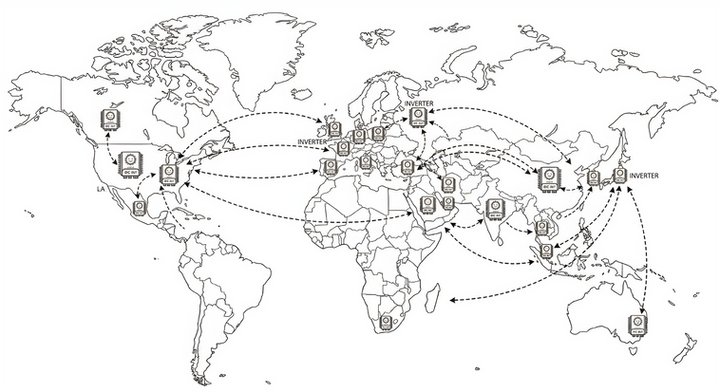
Collective Learning Artificial Intelligence Infrastructure for Inverter Systems
Marten Company does not only develop software that analyzes local data for inverter systems.
Instead, it systematically processes the data obtained from each inverter and feeds it back to the entire infrastructure.
It develops an artificial intelligence-based energy analysis and decision platform that works on the principle of collective learning.
Basic Approach
In traditional systems, each inverter:
works in isolation
limited to its own data
does not benefit from past experience
The Marten approach is this:
Not every inverter is a stand-alone device;
is part of a larger learning system Problem
In existing inverter infrastructures:
The same faults repeat in different areas
systems do not learn from each other
fault information remains local
Knowledge accumulation does not turn into institutional memory
Energy systems produce data, but not corporate intelligence
Marten Solution: Collective Learning
Marten doesn't just analyze the data from inverters;
This incorporates data into the learning and distribution cycle.
How Does the System Work?
1. Data Collection (Edge Layer)
Each inverter:
Generates DC/AC behavior data
records temperature, load and performance data
creates changes over time
2. Behavior and Fault Analysis
Data collected:
differentiated into normal and abnormal behavior
failure processes are modeled
cause-effect relationships are extracted
3. Central Learning (Cloud Intelligence)
These data:
processed in the central artificial intelligence system
repeating patterns are detected
converted into failure and performance models
4. Information Distribution
Learned models:
transferred to the entire inverter infrastructure
produces early warning in similar situations
🔍 Sample Scenario
In an inverter:
the temperature is gradually increasing
load constant
productivity begins to decline
The Marten system analyzes and records this situation:
This behavior is associated with cooling performance degradation
When a similar pattern occurs later on a different inverter:
The system recognizes this situation in advance and produces an early warning
Competencies Provided
Predictive Analysis
The system not only evaluates the current situation;
predicts the future based on past learning
Corporate Memory
data from all inverters accumulates
the system becomes more accurate over time
Knowledge does not disappear, it grows
Continuous Improvement
Marten AI:
updates itself with every new data
learns new fault types
increases accuracy
Reducing Repetitive Errors
Error occurring in a system:
It won't be the same the second time
Technical Architecture
Marten Collective Intelligence consists of three main layers:
Edge Intelligence
Data collection on the inverter
fast local analysis
instant decision making
Central Learning Engine
data merging
model training
pattern analysis
Knowledge Distribution Layer
Transferring the learned information to the entire system
model updates
Learning Supported by Simulation
In addition to the actual data Marten:
generates large-scale failure scenarios
simulates different operating conditions
Includes rare cases in the model
In this way, the system:
not just the past,
also learns the possibilities
Where Marten Differs
Traditional approach:
local analysis
static system
non-learning structure
Marten approach:
collective learning
dynamic model
constantly evolving system
Value Provided
Marten Collective Intelligence:
Allows faults to be detected earlier
reduces repetitive errors
improves maintenance planning
increases system reliability
reduces operational costs
Strategic Location
Marten's goal:
For inverter systems, not only analysis but also
Creating an artificial intelligence standard that learns and develops
Marten Collective Intelligence is not a system that monitors inverters.
Enabling inverters to learn together,
creating corporate memory and making energy systems smarter over time